
Why Physical Gold? The Logic Behind the Real Precious Metal
Anyone who wants to buy physical gold will almost inevitably come across the alternative: a gold ETC, a security traded on the stock exchange that tracks the gold price. Both promise the same price performance. The decisive difference lies not in the price, but in the legal nature of the asset: physical gold is property. A gold ETC is a claim against an issuer. In everyday life, this difference stays invisible – until a system comes under stress. That is precisely the moment that reveals whether an investment actually functions independently of third parties or not.
This article explains the logic behind it: counterparty risk, custodian risk, systemic dependency – and when an ETC still has its place.
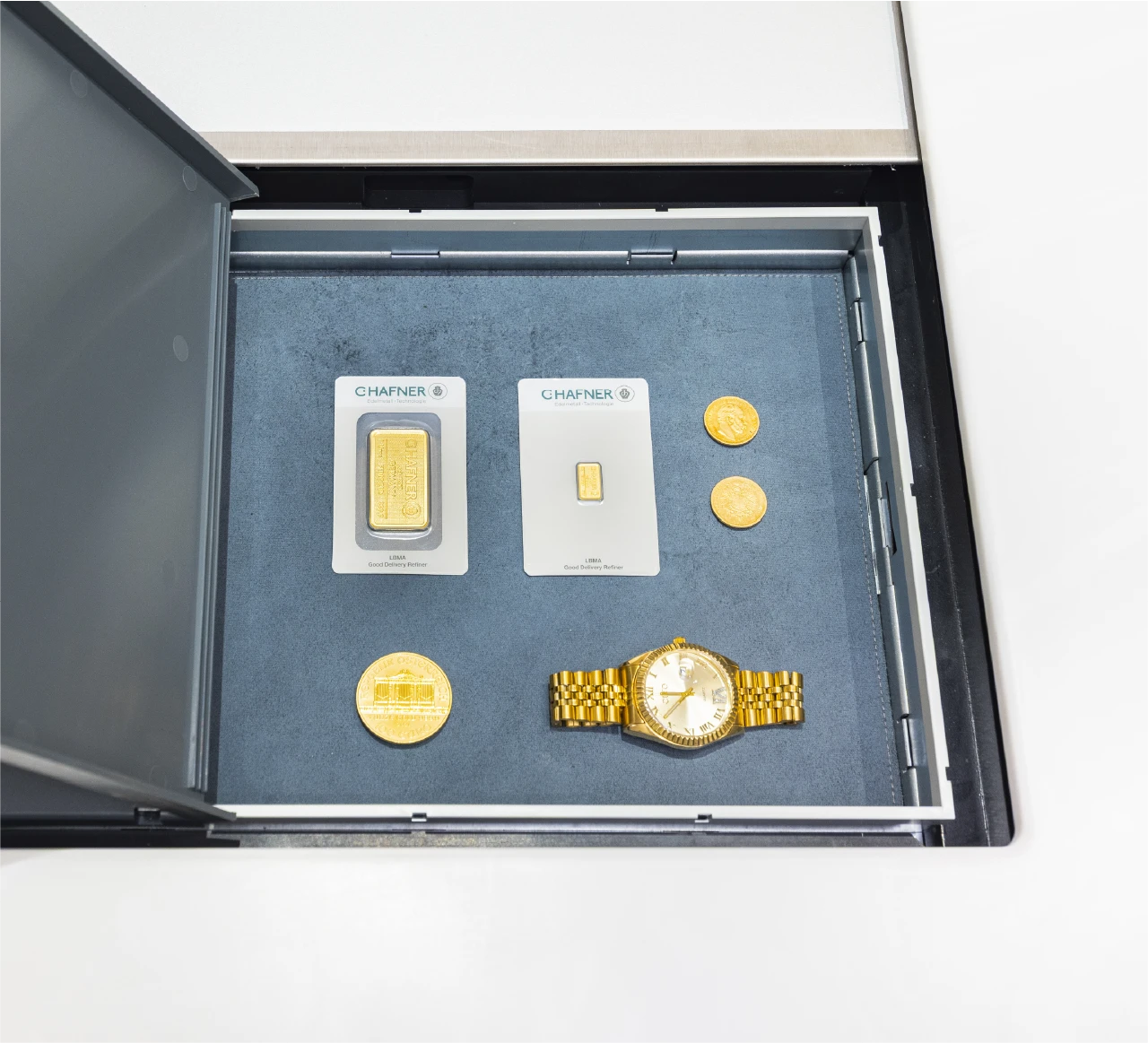
Paper or Metal – the Fundamental Difference
A gold ETC (Exchange Traded Commodity) is legally a bearer bond: a debt instrument through which the issuer commits to holding the equivalent value in gold and paying it out on request. Physical gold – a bar or coin in your own possession – is, by contrast, not a claim against anyone. It is the asset itself.
Germany's financial regulator, BaFin, makes the consequence clear for securities in general: the regulator checks whether issuers and custodians comply with financial market rules – but whether a product is economically sound or structurally risky remains solely the investor's own judgment to make. An ETC remains a security with all the structural risks that come with it. Physical gold simply does not carry this layer of risk.
Counterparty Risk: What Happens if an Issuer Becomes Insolvent
With a gold ETC, the value of your investment also depends on the issuer's solvency – even if the product is fully backed by gold. Xetra-Gold, for example, one of the largest gold ETCs in the German-speaking market with around 173 tonnes in holdings at the end of 2025 according to Deutsche Börse Commodities' annual reports, is 100 percent backed by gold: 95 percent held physically in Clearstream Banking's vaults, the remainder as a delivery claim against the refiner Umicore.
The decisive sentence is found in the fine print: as Deutsche Börse explains in its analysis of issuer risk in ETCs, in the event of the issuer's insolvency, bondholders' claims are not secured. They rank equally alongside the claims of all other creditors competing for the issuer's assets. The gold may physically exist – but whether and how quickly it reaches investors is, in a worst-case scenario, determined by insolvency proceedings, not by a property right.
This question simply does not arise with physical gold in your own possession. There is no issuer that can become insolvent – only the metal itself.
Custodian Risk: Who Actually Holds the Gold?
Even when an ETC is described as "physically backed," that does not mean investors know exactly where their share is stored. Deutsche Börse describes the structure of physically backed ETCs as follows: the precious metal is held by the custodian in the issuer's name – not in the name of individual investors. Between you and the gold typically stand several intermediaries: the issuer, a central custodian, and sometimes further sub-custodians across different jurisdictions.
Every one of these intermediaries has to function for your claim to retain its value. An audit cycle, a trustee, an account statement – none of that replaces direct access to the metal. With physical gold in your own safe deposit box, this entire chain disappears: there is no custodian whose reliability you need to assume, other than your own.
Systemic Dependency: An ETC Only Works if the System Works
A gold ETC is an exchange-traded product. You can buy and sell it as long as the exchange is open, clearing functions, your custodian bank is reachable, and the underlying technical infrastructure is running. In normal market conditions, this is taken for granted – which is exactly why it is rarely questioned.
That taken-for-granted quality is precisely the point: an ETC is a claim mediated by a functioning system. Physical gold requires no exchange, no custodian bank, and no depository to retain its value or change hands. It is independent of the institutions surrounding it – and that is the real substance behind the idea of being "independent of the banking system."
Physical Independence: Gold in Your Hand vs. Gold on Paper
Germany's central bank, the Bundesbank, offers a telling example of this institutional logic. It holds around 3,384 tonnes of gold – the second-largest gold reserve in the world after the United States – distributed across its own vaults in Frankfurt, London, and New York. Even a central bank with unrestricted market access does not forgo physical holdings in favor of pure paper claims. It also has its gold bars regularly audited and publishes a bar list – a level of transparency that multi-layered ETC structures simply do not offer private investors.
What holds true for a central bank applies, at its core, to private individuals too: physical gold means complete control. No intermediary decides on access, storage location, or conditions. This independence is not an abstract principle – it is the actual reason gold has historically served as a store of value outside the banking system.
Liquidity in a Crisis: When Is Physical Gold Faster to Access?
Day to day, an ETC is more liquid: a sell order on the exchange executes in seconds, while selling physical gold requires a dealer, transport, or an in-person appointment. In normal market conditions, that is a genuine advantage of ETCs.
In a real systemic crisis, this picture reverses. The World Gold Council observed a striking contrast in 2025: while gold ETFs worldwide recorded record inflows of 89 billion US dollars, individual ETF holdings simultaneously saw net outflows exceeding 240 tonnes – a sign that institutional and private flows do not move in sync during periods of stress, and that ETC liquidity remains tied to market and trading conditions. If an exchange is closed, a payment system disrupted, or an account frozen, a paper claim is temporarily worthless – regardless of how valuable the underlying gold actually is. Physical gold under your own control remains tradable in every scenario: hand to hand, with no dependency on any system.
When an ETC Still Makes Sense
That does not make a gold ETC automatically the wrong choice. It has a legitimate place – just a different one than physical gold.
For short-term, tactical positions, for instance to benefit from price movements, an ETC is more practical: no transport, no premium, immediate tradability – though most experts advise against speculating on short-term price gains, since gold's primary purpose is preserving value, not generating quick profit. For very small amounts, where the storage and logistics of physical gold are barely worthwhile, an ETC can also be the more sensible option. And for investors who view gold purely as one portfolio component alongside stocks and bonds, with no interest in physical storage, an ETC is the more fitting instrument.
What an ETC cannot do: protect the core of a portfolio against banking, systemic, or counterparty risk – because its own value depends on exactly those factors holding up. Anyone holding gold for genuine wealth protection should therefore keep that portion physical and outside the banking system. That gold holding should also never be reduced to zero, except in an acute crisis – and even physical gold is not a vehicle for short-term speculation, but a deliberately chosen, regularly reviewed building block of one's overall wealth structure.
Conclusion: The Purchase Decision Is Only the First Step
Physical gold does not differ from a gold ETC in its price performance, but in its legal nature: ownership instead of a claim, independence instead of reliance on a system. Once you understand that difference, the next question follows naturally – no longer "ETC or physical?", but "where do I store my physical gold safely?"

Gold Price Trends Explained: The Structural Drivers at a Glance
Gold price trends explained: how real interest rates, central bank policy, the dollar, geopolitics and supply interact – with current data from the World Gold Council and Bundesbank.

Gold as an Inflation Hedge: What the Data Really Shows


Buying Silver: Why You Pay VAT – But Not on Gold
Gold Price Trends Explained: The Structural Drivers at a Glance
Gold as an Inflation Hedge: What the Data Really Shows