
Bitcoin — Wallets, Addresses, Seed Phrases, and What Really Needs to Be Kept Safe
Owning Bitcoin doesn't mean holding physical coins or a file full of "coins." Instead, you control a private key that grants access to your Bitcoin on the blockchain. That's exactly why security and storage always come down to three concepts: address, wallet, and seed phrase. This article explains how these building blocks fit together, which storage strategies make sense, and what matters most when securing your holdings.
At a glance:
- A hardware wallet is the best option for securely self-custodying Bitcoin.
- The seed phrase is the master key to your Bitcoin holdings.
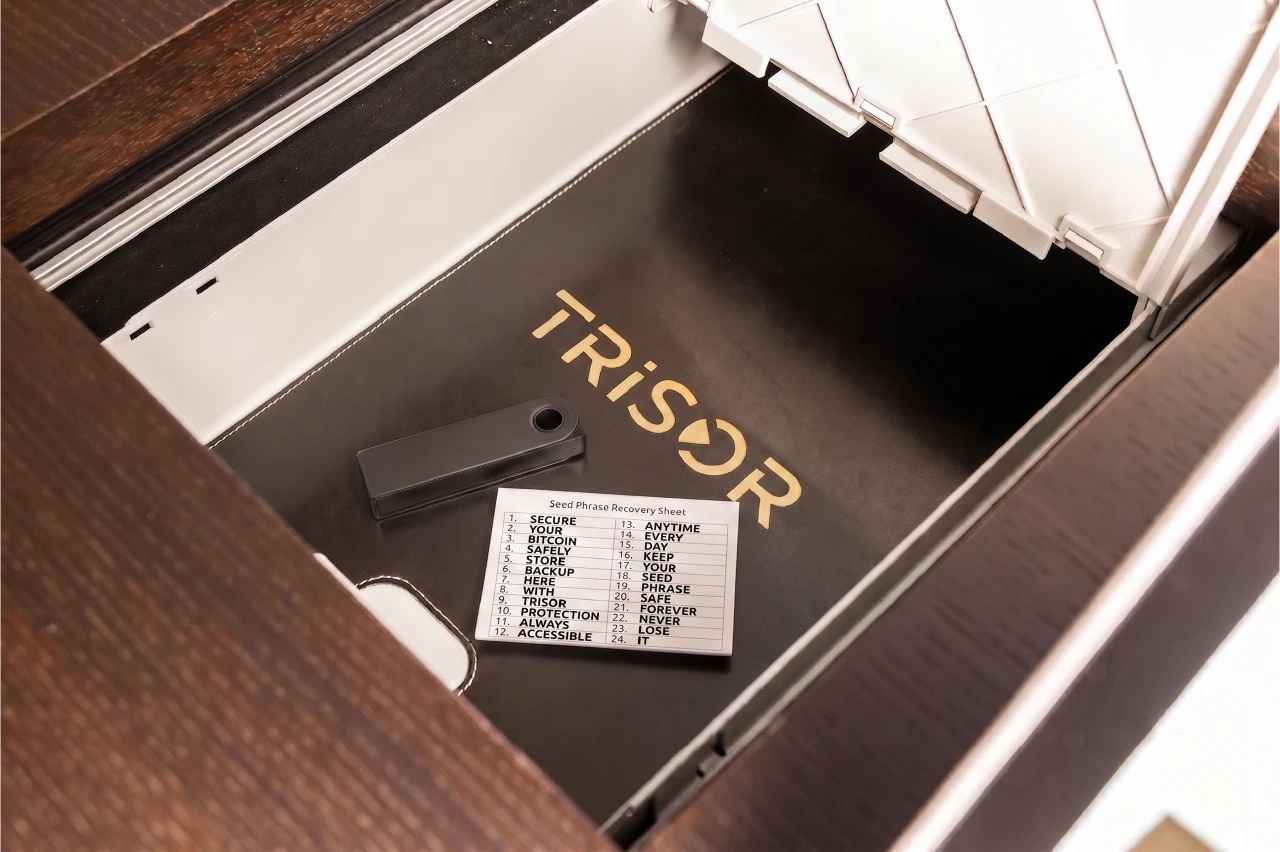
- Storing this seed phrase securely, secretly, and safely — for example in a safe deposit box — is essential.
- Additional, geographically separated copies of the seed phrase increase resilience.
What Is Bitcoin?
Bitcoin is a decentralized, digital monetary system. It works without a bank, without a central authority, and without a traditional account. Instead, Bitcoin relies on a public database, the blockchain, in which all transactions are permanently recorded; on cryptographic key pairs (private key / public key) used to create and sign transactions; and on clearly defined network rules that prevent Bitcoin from being spent twice or without authorization.
What matters is this: no name and no bank confirms ownership of specific Bitcoin. Bitcoin belongs to whoever controls the matching private key. Whoever holds the key has control — whoever loses it permanently loses access.
Like gold, Bitcoin can be held in self-custody or through a service provider. Since many investors view Bitcoin as an independent reserve or emergency asset, more and more are choosing self-custody — often combined with an external storage location such as a Trisor safe deposit box.
The Bitcoin Address
Individual Bitcoin are always assigned to a specific Bitcoin address, which is publicly visible at all times. A Bitcoin address is comparable to an IBAN: you share it so someone can send you Bitcoin. Unlike an IBAN, however, a Bitcoin address is typically not reused for security reasons — modern wallets generate a new address for every transaction.
Example of a Bitcoin address: bc1qaa11bb22cc33dd44ee55yz
Technically, every Bitcoin address is linked to a private key: a public key is first generated from the private key, and the Bitcoin address is then derived from the public key using a hash function.
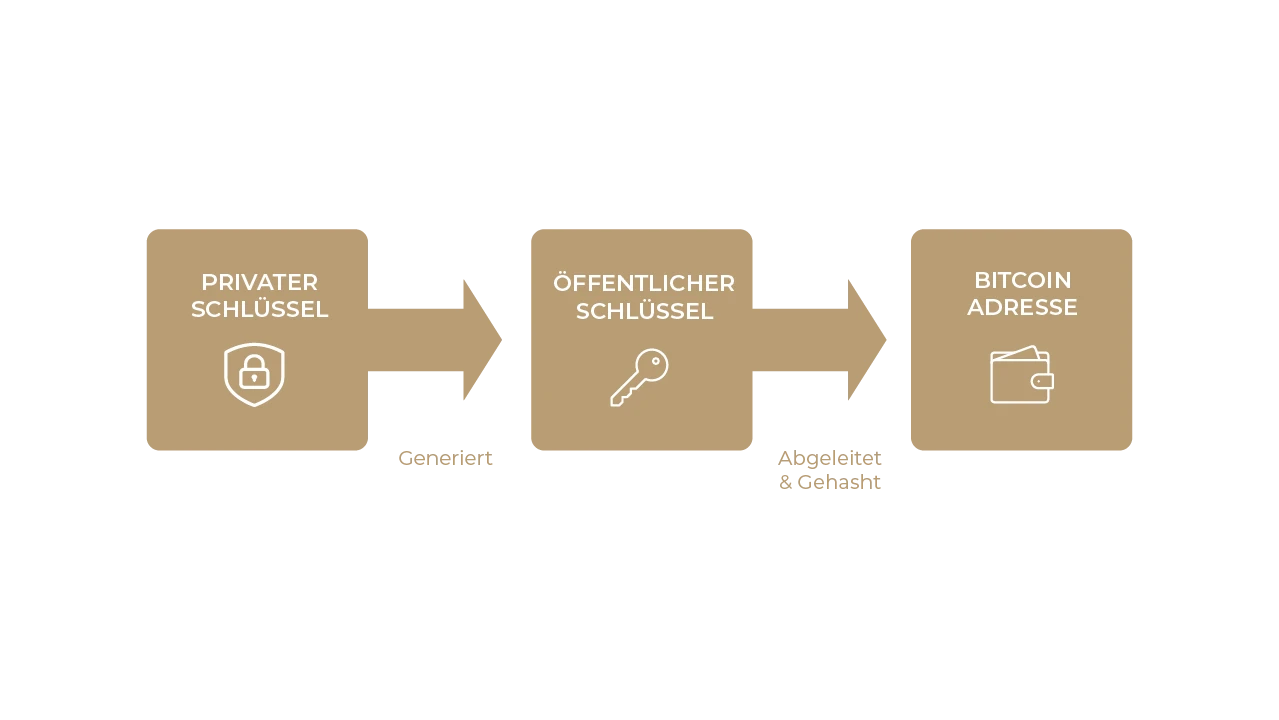
For other cryptocurrencies such as Ethereum or Solana, the process is similar. Unlike Bitcoin, however, there is no security risk in reusing addresses there — so the same address is often used long-term.
Bitcoin Wallet: Managing Keys and Addresses
A Bitcoin wallet is the software or hardware that manages private keys and signs transactions. It generates new key pairs and derives Bitcoin addresses from them. Typical wallet types are:
- Mobile wallets — used as an app on a smartphone
- Desktop wallets — used as an application on a computer
- Browser wallets — used as a browser extension
- Hardware wallets — a dedicated device used solely for wallet management
A hardware wallet is generally recommended for secure self-custody, as it significantly reduces the risk posed by potentially compromised computers or smartphones. Anyone who gains access to a wallet gains direct access to the crypto assets it holds — choosing the right wallet is therefore the first key security decision.
The Seed Phrase and Its Backups
To generate new private keys, a wallet doesn't use arbitrary random values each time; instead, it deterministically derives them from a "master key." This master key is typically represented by the so-called seed phrase (also known as a mnemonic phrase) — a sequence of 12 or 24 words following the BIP39 standard. From this single key, all private keys — and therefore all addresses in a wallet — can be derived, and the entire wallet can be fully restored from it.
For this reason, the words of a seed phrase are often written down on paper or engraved onto a steel plate. This physical backup allows the wallet to be restored if the device is lost or damaged.
Rule of thumb: the seed phrase is the master key to your Bitcoin holdings.
Anyone with access to the seed phrase can restore the wallet and gain full access to the Bitcoin held within it. Three security factors are therefore especially important:
- Random generation — a high degree of randomness (entropy) is required so no one can guess the seed phrase. This is generally only guaranteed by hardware wallets or genuine random processes such as dice rolls.
- Secret storage — a seed phrase should never be photographed or stored digitally. Anyone with access to it has full access to the wallet.
- Protected storage — since losing the seed phrase means a total loss of the Bitcoin held, multiple physical backups kept at separate locations — for example, at home and in a safe deposit box — significantly reduce this risk.
Estate Planning: Documentation for the Event of Death
Additional documentation is advisable for emergencies — such as recovery instructions, notes on the wallet structure, and contact details for trusted individuals. Without this information, Bitcoin is often irretrievably lost in the event of death, since no one else knows the seed phrase or wallet structure. To learn how Trisor lets you set up access rights for emergencies and inheritance in general, read our article on Estate Planning with Trisor.
Checklist: Secure Bitcoin Storage in 5 Steps
- Use a hardware wallet — significantly more secure than software wallets
- Choose a secure, unguessable PIN for the hardware wallet
- Create a physical backup of the seed phrase — on paper or metal
- Keep backups in multiple, geographically separate locations — e.g., at home and in a safe deposit box
- Prepare documentation for the event of death — including instructions and contact persons
Where Should You Store Your Seed Phrase Securely?
Your own home offers quick access but little protection against fire, water, burglary, or unintended access by others. A Trisor safe deposit box complements your wallet with a professionally secured, geographically separate storage location — with 24/7 access, multi-factor access control, and a clearly plannable handover in the event of death. This lets you securely store your seed phrase, or part of it, without giving up quick everyday access.
To learn more about storage strategies such as multi-signature and split seed phrases, and how different storage locations compare, read our article on Bitcoin storage strategies.
Next Step
Want to store your seed phrase or hardware wallet securely and safely?
Book your free consultation now and find out how a Trisor safe deposit box complements your Bitcoin storage.
Safe Deposit Box Insurance 2026: What the Latest Stiftung Warentest Comparison Shows
Safe deposit box insurance in the 2026 Stiftung Warentest comparison: which providers really pay out, what cash exclusions mean, and how Trisor protects you.
Why Physical Gold? The Logic Behind the Real Precious Metal
How to Buy Gold: A Beginner’s Complete Guide
How to Store Jewelry Safely – Protecting Its Value and Beauty
Why Physical Gold? The Logic Behind the Real Precious Metal
How to Buy Gold: A Beginner’s Complete Guide